3D-printed drone parts article-hero-bg
Nov 16, 2026 Kay Wackwitz
7 min read
Drones and 3D Printing

3D-Printed Drone Parts: What Can (and Can't) Be Printed Today?

3D-printed drone parts have been in use for years, first as prototypes and increasingly in series production. Airframes, payload mounts, and housings come off the printer. The question is no longer whether additive manufacturing (AM) works for drones, but how far it can go.

This article opens a three-part series by Drone Industry Insights together with MTDG, the parent organization of America Makes, the U.S. National Additive Manufacturing Innovation Institute.

Part 1 covers the basics: why drone companies print parts, which 3D-printed drone parts are already in use, how civil and defense users apply the technology, and where it reaches its limits.

Why drone companies use 3D printing?

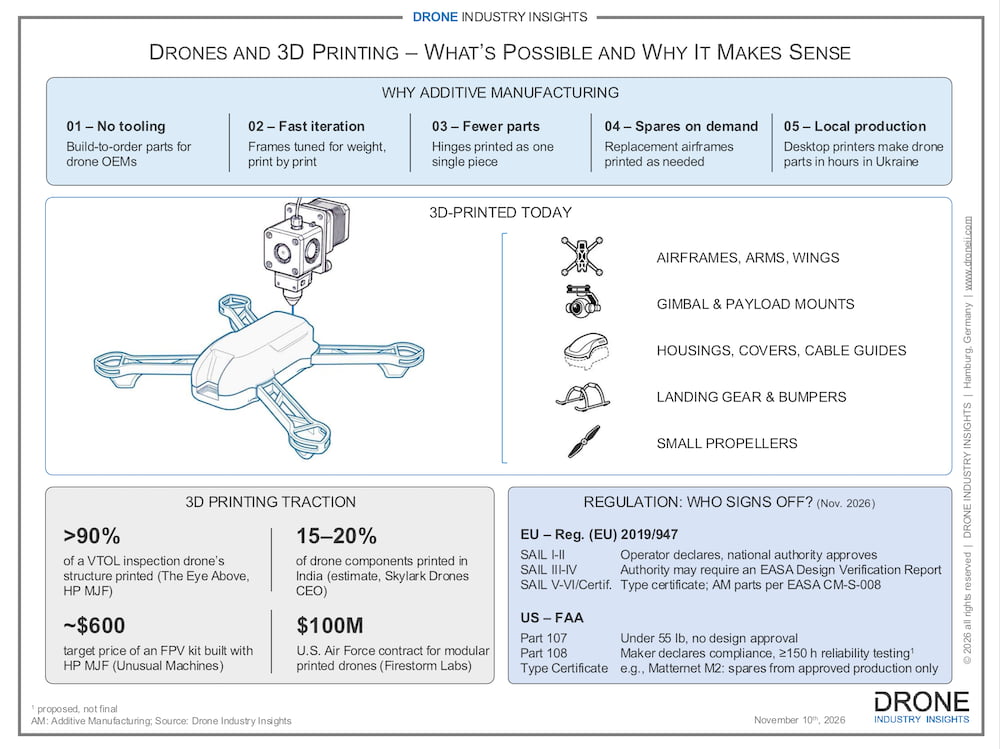
Five advantages explain why additive manufacturing has found a place in drone production. Each is already visible at drone companies today.

  • No tooling. Small batches need no molds, so parts can be made to order. Indian supplier Imaginarium prints components for drone makers that build only when orders come in.
  • Fast iteration. A design change does not mean a new mold. At Ukrainian manufacturer Sparrow Avia, “3D printing has allowed Sparrow’s engineers to rapidly iterate drone frames to optimize weight and durability”.
  • Fewer parts. Assemblies such as hinges can be printed as one piece. At Euro Defence Expo 2026 in Essen, such single-piece hinges were on display. VTOL inspection drone maker The Eye Above prints more than 90% of its structure, cutting weight and simplifying assembly.
  • Spare parts on demand. A digital inventory replaces parts on the shelf. U.S. manufacturer Firestorm Labs prints only what is needed, from replacement airframes to custom payload mounts.
  • Local production. Parts are made close to where drones operate. “Across Ukraine, thousands of 3D printers are producing drone parts in hours instead of weeks,” reports. Josef Prusa, CEO of Czech printer maker Prusa Research, explains why speed matters: interceptors designed the traditional way are “outcompeted by the quicker innovation of the enemy. So you need to be able to iterate quickly.”
“Additive manufacturing gives the drone industrial base something traditional tooling never could: the agility to iterate rapidly and produce mission-critical structures locally without fragile supply chain dependencies. Making that capability scalable requires consistent, trusted qualification standards across every distributed print node.”
– Dr. Dean L. Bartles, President & CEO, MTDG

3D-printed drone parts: What is printed and what isn't?

Today’s 3D-printed drone parts are structural and mechanical; energy, propulsion, and electronics are not printed. The dividing line follows physics more than technology maturity: a printer shapes material, but it does not make battery chemistry, magnets or semiconductors.

Printed today Not printed
Airframes, arms, fuselage and wing structures Battery cells
Gimbal and payload mounts Motor windings, magnets, bearings
Housings, covers, cable guides Flight controllers and other electronics
Landing gear and crash bumpers Cable harnesses
Small propellers, mainly for FPV drones Servos, sensors, cameras


Material choice depends on the part. Polyamides such as PA12 or PA11 suit structural parts, flexible TPU absorbs crash loads, and carbon-fiber-reinforced nylon adds stiffness. Printed batteries that conform to a drone’s shape are under development but not yet in series use.

Drone companies that already use 3D printing can be found in ASTRA Intelligence, Drone Industry Insights’ database of drone companies.

Find 3D-Printing Drone Companies

  • ASTRA Intelligence is a 100% FREE drone and mobile robot platform
  • 1,700+ listed companies
  • 7,200+ listed products and services across all domains
  • Search an accurate, structured database for suppliers
  • Present companies and products/services on a platform built specifically for the mobile robot industry
  • Build a local supply chain with valuable leads

What are the differences between civil and defense 3D-printed drone parts?

Both markets use 3D-printed drone parts, but for different reasons: civil manufacturers mainly for prototyping, cost, and design freedom; defense users for speed and supply security.

Civil. In inspection, The Eye Above uses printed structures for its VTOL drone. In India, Skylark Drones’ CEO estimated that 15–20% of drone components in the country are 3D printed. U.S. FPV maker Unusual Machines targets kits at around $600 with printed parts. CEO Allan Evans says printing “allows us to produce higher quality products that meet the performance requirements of FPV drones”

Defense. Firestorm Labs builds drones in containerized print cells and holds a $100 million U.S. Air Force contract for modular, printed drones. In Ukraine, the Ministry of Defense integrates 3D-printed parts and manufacturing services into its official Library of Components. At “Euro Defence Expo 2026”, printer systems with 12- and 42-liter build volumes for polymer parts were presented to defense buyers.

Even for low-cost one-way drones, material is not arbitrary. Crash-resistant TPU or stiff reinforced polymers are selected deliberately, because a part that fails in flight costs the mission.

Where does 3D printing reach its limit?

Volume is the main limit. Once a design is frozen and quantities grow, molding processes usually produce each part more cheaply. Skylark Drones described this pattern in India: manufacturers print while designs change and switch to injection molding once they standardize.

Speed alone does not mean printing either. German manufacturer Stahlkontor thermoforms the shell set for its EXTALON one-way drone in under three minutes.

The second limit is the bill of materials. 3D-printed drone parts lower the cost and lead time of structural components, but batteries, motors, and electronics often make up the larger share of a drone’s cost and supply risk. 3D printing shortens part of the supply chain; it does not replace it.

Whether an in-house printer pays off depends on part volume, materials, and machine class. A later article in this series will look at the business case.

Global Drone Market Report 2026-2035

  • Extensive 244-page drone market report with in-depth analysis, industry definitions, & extended 10-year forecast.
  • Market Size broken down
    • by Recreational & Commercial
    • by Industry Segment (hardware, software, services)
    • by Application Method (Mapping, Inspection, etc.)
    • by Unit Sales
    • by Region and Country
  • Market Developments and Trends
  • Drone Regulation
  • Drone Investments
  • Drone Company Market Shares

Regulation: Who signs off on 3D-printed parts?

Aviation rules do not ban printed parts, but they tie every part to an approved design and its maintenance instructions. How strict this is depends on the operation’s risk.

In the EU, Regulation (EU) 2019/947 scales requirements with risk. For higher-risk operations in the specific category, authorities may require an EASA Design Verification Report; certified operations need a type certificate, and EASA’s Certification Memorandum CM-S-008 sets expectations for additively manufactured parts. In the U.S., most commercial drones fly under Part 107 without design approval. The proposed BVLOS rule, Part 108, would let manufacturers declare compliance with accepted consensus standards; it was not final as of November 2026. Type-certified drones such as the Matternet M2 follow classic aviation rules for replacement parts.

One question remains open in both systems: is a spare part printed by a third party a change to the approved design, and who is responsible for it?

Outlook: From prototype tool to supply chain factor

3D-printed drone parts are established for structural and mechanical components, from airframes to payload mounts, while batteries, motors, and electronics still come from specialized suppliers. Civil manufacturers print mainly for prototyping, cost, and design freedom; defense users for speed and supply security.

3D printing has moved from the prototype workshop into drone production, and the defense market is accelerating that shift. The next questions are less about whether parts can be printed and more about which process fits which part, and how 3D-printed drone parts are qualified across civil and defense supply chains.

For operators, the open question on third-party spare parts will decide how far on-demand printing can go in day-to-day maintenance. For manufacturers, the choice between printing and molding remains a question of volume and design maturity. As demand for traceable, locally made components grows, qualified and distributed print capacity could become part of supply chain planning rather than a workshop tool.

Dear DII-Team, I would like to join the research subscription waiting list. Please contact me asap for more information.

THANK YOU!

Your sign-up request was successful! Please check your email inbox to confirm.

MY CART

There are no product in cart yet