
6 min read
Rule-Makers, Not Technology, Are Setting the Pace for Drones in 2026
Drone Industry 2026: What's Really Moving the Industry
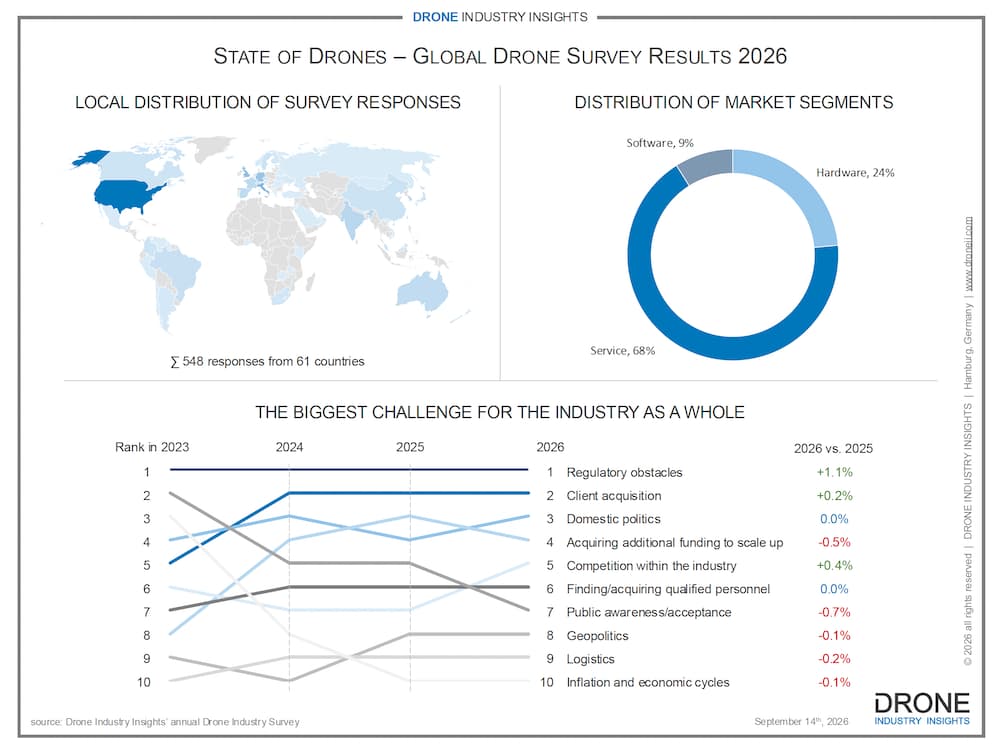
Drone Industry 2026: The commercial drone industry went through a notably stable phase of development in the past year. That picture emerges from the ninth edition of the annual Drone Industry Survey by Drone Industry Insights, which collected 548 responses from 61 countries between June and August 2026. This article summarizes the key findings.
Who took part in the survey?
Participation declined compared to previous years: from 964 responses across 94 countries in 2024, to 768 responses from 87 countries in 2025, and now 548 responses from 61 countries in 2026. Europe accounted for the largest share of participants at 48 percent, followed by North America at 23 percent and Asia at 15 percent. Most responses came from the US, Italy, the UK, and Germany.
The service sector — companies in drone operations, consulting, training, engineering, and public media — remains the largest segment among respondents at 67.5 percent, ahead of hardware manufacturers at 23.5 percent and software providers at 9 percent. Nearly half of participating companies (48 percent) employ fewer than ten people, confirming that the industry continues to be shaped largely by small businesses.
What are drones actually being used for in 2026?
Mapping and surveying remain the dominant application, used by 38 percent of surveyed drone operators — a share that has grown steadily since 2023, when it stood at 34 percent. Inspection ranks second at 26 percent, holding steady compared to last year. Photography and filming, by contrast, continue their decline, suggesting that commercial imagery is becoming more advanced and is increasingly embedded within larger mapping or inspection projects rather than standing as a use case on its own.
The reasons companies adopt drones show a shift back to the pattern seen in 2024: “improving work safety” is once again the top reason, ahead of “saving time.” In 2025, saving time had briefly taken the lead. Saving costs remains, as in previous years, the least important motivator — an indication that safety, efficiency, and quality often outweigh pure cost reduction in practice.
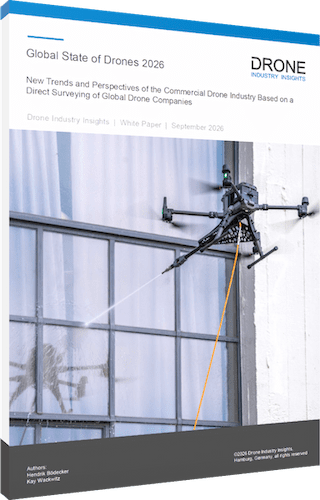
Global Sate of Drones 2026 White Paper
The FREE Global State of Drones Report 2026 is the annual white paper that measures the state of the global industry. This white paper is based on the Global Drone Industry Survey, the most wide-reaching and inclusive global survey of the drone industry.
- Global Participation
- Drone Companies’ Business Focus and Size
- Methods and Reasons to Adopt Drones
- Expectations vs Reality
- Top Challenges
- Market Drivers
How does the industry rate its own development?
Each year, the survey captures both actual business performance over the past twelve months (“reality”) and expectations for the next twelve months (“expectations”), rated on a scale from 0 to 10. In 2026, expectations stand at 6.7 points and reality at 6.2 points. The 0.5-point gap between the two is the smallest recorded since the survey began, signaling that forecasts and actual market development are converging.
Development varies across business types. Components and systems manufacturers show the most consistent upward trend of the past seven years, with expectations reaching 7.9 points. Software manufacturers, last year’s strongest performer, have cooled off noticeably in 2026. Drone service providers report a further slight decline in business results, while integration and engineering companies are recovering from a weak 2024.
Where are drone companies allocating their resources in 2026?
Marketing and sales remain the top resource priority at just under 28 percent (down one percentage point from last year) — a position it has held for years. Software product development follows with a rising trend, now at 20 percent. Funding stands at 16 percent and is becoming increasingly critical, as investment activity has declined since peaking in 2021.
Priorities differ sharply by business model. Hardware and component manufacturers direct most resources into product development (27 and 40 percent, respectively), software companies focus 40 percent of resources on software, and drone service providers place the strongest emphasis on marketing and sales at 33 percent — unsurprising, given their direct proximity to clients.
What are the biggest challenges facing the industry?
Regulatory obstacles — such as certification processes and restrictions on flying BVLOS or at night — remain by far the biggest challenge in 2026, and have even gained relevance compared to last year (+1.1 percentage points, the largest increase of any factor surveyed). Client acquisition ranks second, followed by domestic politics, such as import/export restrictions, in third place. The latter has pushed funding out of the top three.
Notably, public awareness and acceptance of drones saw the sharpest decline in relevance, dropping 0.7 points to seventh place — suggesting that, from the industry’s perspective, this issue is becoming less urgent, whether because acceptance is genuinely improving or because other topics have gained relative weight.
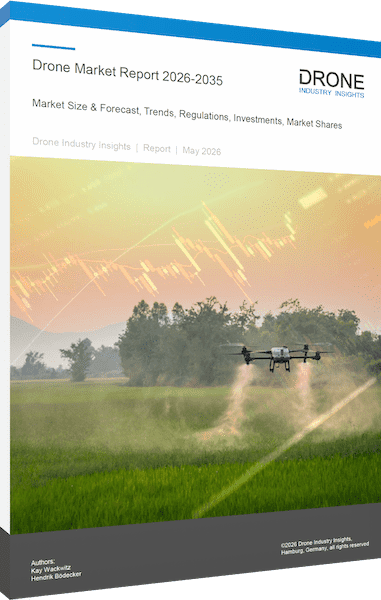
Global Drone Market Report 2026-2035
- Extensive 244-page drone market report with in-depth analysis, industry definitions, & extended 10-year forecast.
- Market Size broken down
- by Recreational & Commercial
- by Industry Segment (hardware, software, services)
- by Application Method (Mapping, Inspection, etc.)
- by Unit Sales
- by Region and Country
- Market Developments and Trends
- Drone Regulation
- Drone Investments
- Drone Company Market Shares
Who is driving market development the most?
Rule-making authorities are once again rated as the single most important market-driving actor: 58 percent of respondents identified them as such, up from 56 percent last year. This means regulation is not only the industry’s biggest challenge but also its most influential force for market development — and its importance continues to grow. Drone manufacturers rank second at 50 percent, followed by drone operators and service providers at 41 percent. Software manufacturers stand at 28 percent, organizations focused on safety concepts such as JARUS or ASTM at 20 percent, and drone associations at 12 percent.
Conclusion
The findings of the Global State of Drones 2026 survey point to an industry in a phase of relative stability: expectations and reality are converging, applications are consolidating around mapping, surveying, and inspection, and regulation remains both the biggest brake and the most important enabler of further growth. Companies that allocate resources deliberately across market development, product development, and regulatory preparedness are likely to benefit most.

Named one of the most influential people in the commercial drone industry, Kay established Drone Industry Insights as the leading drone market research consultancy in 2015. As well as personally consulting on projects and producing reports, he frequently speaks at conferences, seminars, and expos.
- 1 Who took part in the survey?
- 2 What are drones actually being used for in 2026?
- 3 How does the industry rate its own development?
- 4 Where are drone companies allocating their resources in 2026?
- 5 What are the biggest challenges facing the industry?
- 6 Who is driving market development the most?
- 7 Conclusion