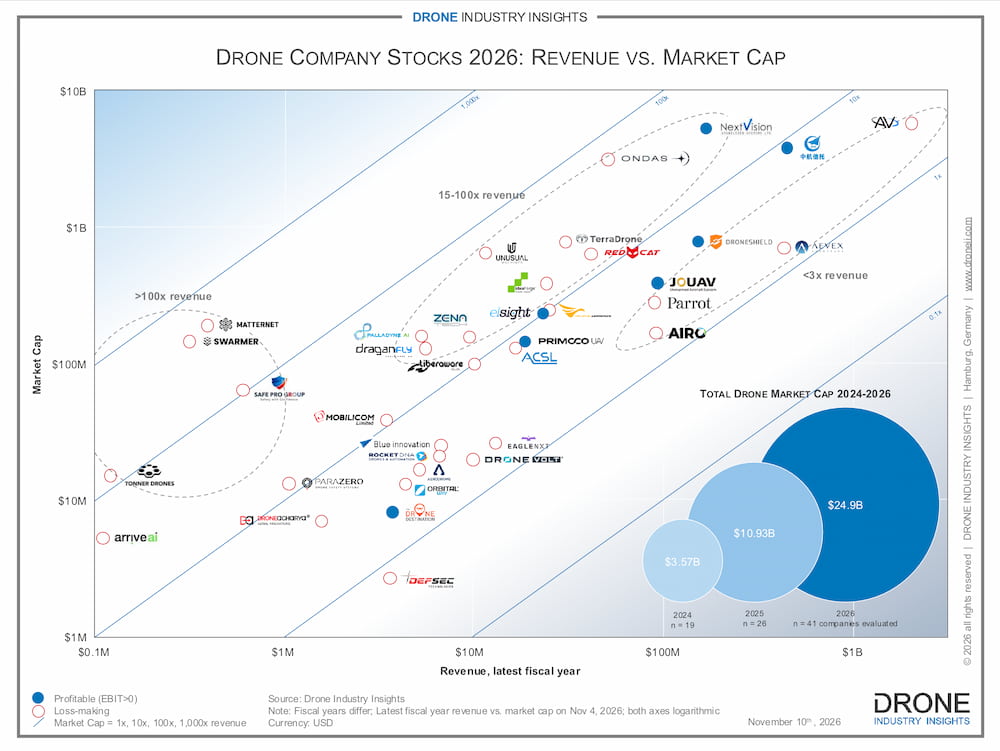
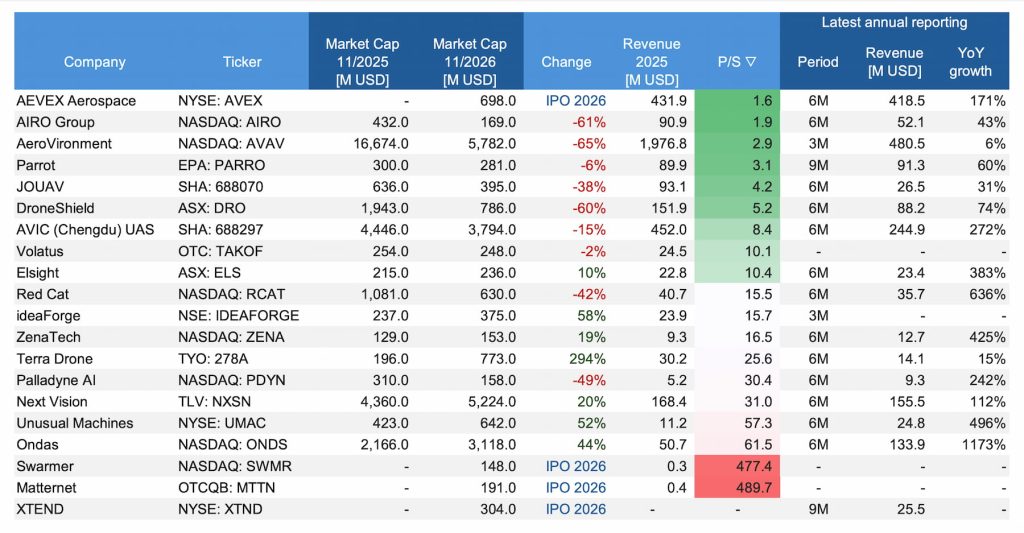
Revenue at listed drone companies is growing strongly, driven mainly by defense demand, while profits remain the exception. Valuations reflect this: loss-making companies have a higher median P/S than profitable ones, so a large share of market cap is based on expected growth. Whether these expectations are met will become clear in the coming quarters.
Differences between segments: Suppliers of components used across many drone platforms combine growth with profitability most clearly. Next Vision, a supplier of stabilized camera payloads, increased revenue by 112% in the first half of 2026, with an operating margin of 58%. Elsight, a supplier of communication systems, reported 383% revenue growth and a small operating profit. Established defense suppliers report large order backlogs; AeroVironment’s funded backlog rose 37% to $1.5 billion. For high-volume products such as one-way attack drones, the Pentagon’s Drone Dominance program targets a unit price decline from $5,000 to $2,300. At companies growing mainly through acquisitions, such as Ondas and ZenaTech, operating losses have grown alongside revenue so far.
Private vs. public valuations: Shield AI’s private valuation of $28.8 billion exceeds the combined market cap of all 41 listed drone companies. On the stock market, valuations have moved more moderately: excluding Next Vision and Ondas, the companies from the 2025 edition lost 2% in market cap, and two of the three 2026 IPOs traded well below their issue price on November 4. Possible IPOs of neo-primes would show whether public investors confirm private valuations.
Comparison with eVTOL: The eVTOL sector also saw listings via SPACs and valuations based on expected business. Lilium filed for insolvency in 2024 and again in 2025; Volocopter filed for insolvency in December 2024 and was acquired by Wanfeng in 2025. Unlike eVTOL developers at the time, many defense drone companies already generate revenue from government customers and report order backlogs. However, their demand depends heavily on defense budgets and the war in Ukraine.
At a median of 9× revenue, a large share of the drone market cap in 2026 is based on expected growth. Revenue is rising across the sector, driven largely by defense demand, while operating profits remain the exception – the coming quarters will show which companies can turn that growth into earnings. Most US-listed companies report third-quarter results in mid-November.