
7 min read
Legal Uncertainty in the Drone Industry
The Hidden Price of Regulatory Ambiguity
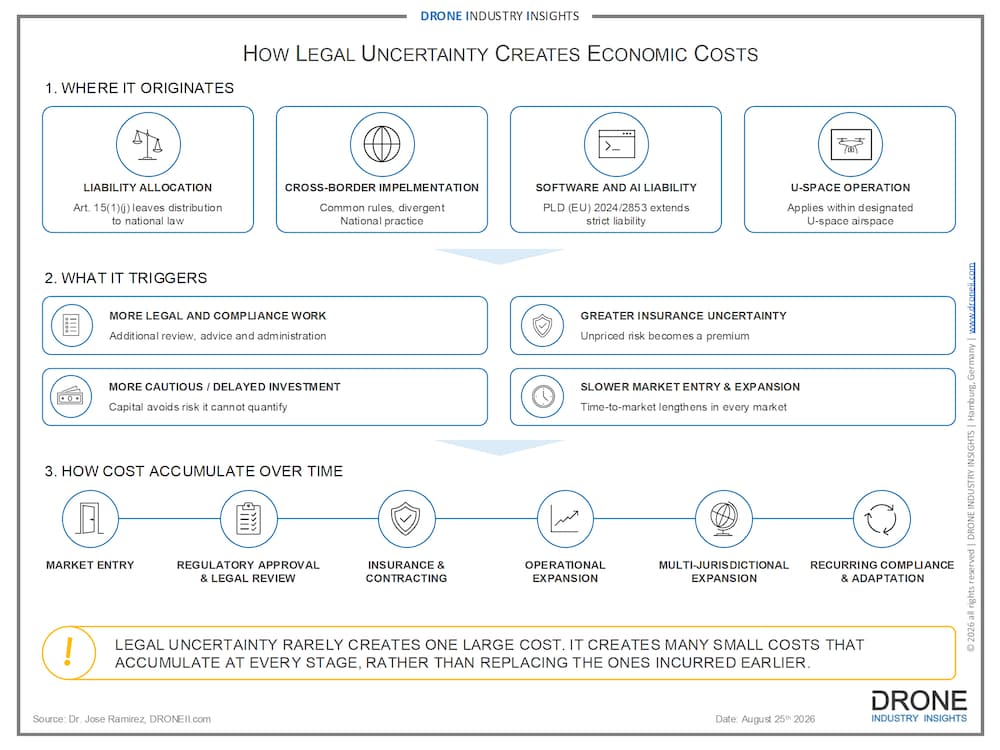
Legal uncertainty rarely makes headlines. Yet, in my assessment, it has become one of the most underestimated factors shaping commercial decisions across the European drone sector. It influences how insurers assess risk, how investors evaluate opportunities, and how confidently companies expand into multiple national markets — whether through operations that physically cross a national border or through separate operations in more than one Member State.
Unlike technical challenges, its costs rarely appear as a single invoice. They emerge gradually through additional legal advice, compliance reviews, insurance negotiations, and delayed investment decisions. Individually manageable, they collectively become a significant constraint on growth.
This article examines why legal certainty has become an economic issue, not only a legal one, and where the commercial costs of uncertainty are already being felt throughout the industry.
Why Does Legal Uncertainty in the Drone Industry Matter Commercially?
Businesses do not expect a world without risk. They expect to understand the risks they take and make informed commercial decisions.
Europe already has one of the world’s most advanced regulatory frameworks for commercial drone operations. However, under Regulation (EU) 2021/664, Member States remain responsible for designating U-space airspace and determining the services required within it. Companies operating in more than one Member State may therefore encounter different national practices, even though they operate under common EU rules.
That gap carries an economic cost. Although Regulation (EU) 2021/664 requires USSPs to establish arrangements specifying the allocation of liability (Article 15(1)(j)), it does not harmonize how liability should be distributed. Those arrangements remain dependent on national law.
The same incident may lead to different legal outcomes depending on the jurisdiction. EU drone regulations do not harmonize tort law, leaving operators to navigate a patchwork of national regimes — strict liability in one Member State, fault-based liability in another just across the border.
The Gatwick Airport incident of December 2018 illustrates the consequences. Drone sightings triggered roughly 33 hours of disruption, affecting around 140,000 passengers and causing losses estimated at around £50 million, largely borne by airlines. Two suspects were arrested and released without charge. No operator was ultimately identified, no prosecution was brought, and the losses remained where they fell.
A parallel form of regulatory friction is evident in the United States. Under 14 CFR Part 107, commercial operators seeking to conduct certain advanced operations, including BVLOS operations, must currently obtain an FAA waiver unless another regulatory pathway applies. On 7 August 2025, the FAA published a Notice of Proposed Rulemaking for a new, separate rule — Part 108 — intended to move qualifying BVLOS operations away from case-by-case Part 107 waivers toward a scalable, performance-based framework (accompanied by proposed Part 146 for third-party service providers). The US experience therefore illustrates the same commercial principle: when routine operations depend on individual regulatory approvals, compliance effort and time-to-market can accumulate even within a single national market.
Legal certainty is not merely a legal objective. It is an economic advantage.
How Does Legal Uncertainty Impact Drone Insurance Pricing?
Insurance is built on one principle: risk can be priced when it is understood.
For commercial drone operations, that understanding remains incomplete. Many applications have limited historical claims data, and liability may involve operators, manufacturers, and software providers simultaneously. The recently adopted Product Liability Directive (EU) 2024/2853 further expands liability for defective products by extending strict liability to software and AI-enabled products integrated into drone systems.
When legal responsibility remains uncertain, insurers reflect that uncertainty in their underwriting. The result is not simply higher premiums but a higher cost of doing business, particularly for BVLOS operations and businesses operating across multiple jurisdictions. For smaller operators in particular, the uncertainty premium can represent a disproportionate share of their operating costs, creating a barrier to entry unrelated to operational capability.
This is not a market failure. It is how insurance works. When uncertainty cannot be priced with confidence, it is reflected in the premium.
Why Do Investors Treat Legal Uncertainty as a Price Risk?
Although investments are surging, investors clearly do not expect risk-free businesses. They expect businesses whose risks can be identified, assessed, and managed.
Before committing capital, they ask direct questions. Is the business model legally sustainable? Could regulatory changes affect profitability? Would a serious incident expose the company to unquantifiable liabilities?
When legal outcomes remain unpredictable, investors seek higher returns, conduct more due diligence, or postpone investment. Capital does not avoid innovation. It avoids uncertainty it cannot price.
Global Drone Market Report 2026-2035
- Extensive 244-page drone market report with in-depth analysis, industry definitions, & extended 10-year forecast.
- Market Size broken down
- by Recreational & Commercial
- by Industry Segment (hardware, software, services)
- by Application Method (Mapping, Inspection, etc.)
- by Unit Sales
- by Region and Country
- Market Developments and Trends
- Drone Regulation
- Drone Investments
- Drone Company Market Shares
Why Is Operating Across Multiple Jurisdictions Still Harder Than It Seems?
Europe has made significant progress toward harmonizing drone regulation through Regulations (EU) 2019/947 and 2019/945, as well as the U-space framework established by Regulation (EU) 2021/664.
However, harmonized legislation does not imply identical implementation. Each Member State designates U-space airspace following a national risk assessment, and national tort and administrative regimes continue to differ — generating additional legal, administrative, and insurance costs for operators expanding into multiple Member States. The U-space liability arrangements above apply only within designated U-space airspace, which so far covers only limited zones. Here, “cross-border” should be understood broadly: it may refer either to an operation that physically crosses a national border or to a business conducting separate operations in two or more EU countries.
Technology can scale quickly across borders. Legal certainty takes longer to catch up.
What Is the Cumulative Cost of Legal Uncertainty?
Together, these costs function as an invisible tax on the drone industry, diverting resources from innovation to managing uncertainty.
No single cost is decisive. Together, they raise operating costs, slow market entry, and encourage more cautious investment.
How Can the Industry Reduce Legal Uncertainty Today?
The drone industry has solved extraordinary technical challenges. The next challenge is not technical. It is legal.
Europe already has the regulatory foundations. The priority now is to take targeted action:
- EASA should continue developing practical guidance and acceptable means of compliance to promote greater consistency in U-space implementation.
- National Aviation Authorities should work toward more harmonized application of the framework to reduce unnecessary compliance burdens for operators active in more than one Member State.
- The insurance sector should continue refining risk models based on operational evidence rather than on legal ambiguity. As claims data expands and liability frameworks mature, premiums should more accurately reflect actual exposure.
- Operators and manufacturers should view legal planning as a strategic investment, not a compliance exercise.
Integrating legal risk assessment into business planning from the outset reduces transaction costs, strengthens investor confidence, and facilitates expansion across multiple EU jurisdictions.
None of these measures requires fundamental legislative reform. Together, they would improve legal predictability, reduce commercial friction, and support the sustainable growth of the European drone market.
The window of opportunity is real. As the global drone market matures, the jurisdictions that offer the greatest legal certainty will attract the most investment, the strongest operators, and the most innovative business models. Europe has the regulatory foundations to lead. The question is whether it will act quickly enough to capitalize on them.
Innovation attracts attention. Legal certainty attracts capital. Capital transforms innovation into a sustainable industry.

Dr José Ramírez is a Spanish aviation and corporate lawyer with 28 years of legal practice and a member of the Madrid Bar Association (ICAM). He holds an MBA from ESADE, a Master’s in Aviation Management, a PhD in Airport Marketing, and is currently a doctoral researcher in EU aviation competition law. He advises internationally on drone regulation, cross-border aviation law and European aerospace regulation. He can be reached at jose.ramirez@icam.es
- 1 Why Does Legal Uncertainty in the Drone Industry Matter Commercially?
- 2 How Does Legal Uncertainty Impact Drone Insurance Pricing?
- 3 Why Do Investors Treat Legal Uncertainty as a Price Risk?
- 4 Why Is Operating Across Multiple Jurisdictions Still Harder Than It Seems?
- 5 What Is the Cumulative Cost of Legal Uncertainty?
- 6 How Can the Industry Reduce Legal Uncertainty Today?