
5 min read
The US$83 Billion Potential: The Drone Market is Set to Nearly Double by 2035
Understanding the Drone Market Growth in 2025 and Beyond
The drone industry has moved well beyond proof of concept. What was once a niche technology driven by hobbyists and early adopters has matured into a global, multibillion-dollar ecosystem spanning services, software, and hardware. With the latest Drone Market Report 2026–2035, Drone Industry Insights is publishing the most comprehensive market forecast to date — extending the outlook to a full decade for the first time.
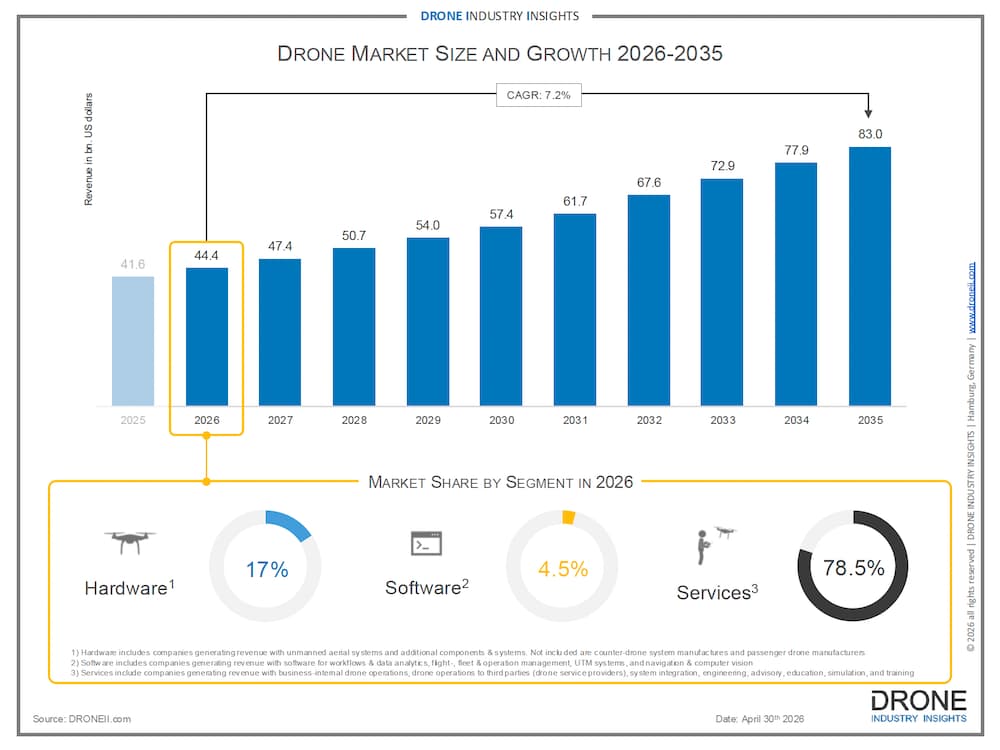
The civil drone market is projected to grow from US$44.4 billion in 2026 to US$83.0 billion by 2035, reflecting a compound annual growth rate (CAGR) of 7.2%. This forecast covers the entire civil drone market, including commercial, recreational, and dual-use applications such as police, firefighting, and emergency medical services. Not included are military drones, counter-drone systems, and passenger-carrying platforms.
Market Segments: Services Remain Dominant
The 2026 segment breakdown reinforces a familiar pattern. Services continue to account for the lion’s share of the civil drone market at 78.5%, including drone service providers, system integrators, engineering firms, consultancies, and training organizations. Hardware — including manufacturers of drone platforms, components, and systems (excluding counter-drone and passenger-drone manufacturers) — accounts for 17% of the market. Software — including workflows, data analytics, flight and fleet management, UTM systems, navigation, and computer vision — accounts for 4.5%.
While services dominate by market share, the hardware segment remains the fastest-growing, driven by rising demand for mass production and the scaling of national supply chains — a trend closely linked to the expanding dual-use market.
Industry and Application Trends: Familiar Leaders, Accelerating Newcomers
In 2026 and across industries, Construction is the largest vertical for commercial drone use. Inspections of pipelines, power lines, wind turbines, offshore platforms, and refineries remain the core use case, where drones deliver clear operational advantages. Energy and Agriculture follow as established verticals with steady growth.
Among application methods, mapping and surveying continue to lead globally. Despite ongoing regulatory headwinds, drone delivery remains a fast-growing application method, with healthcare (vaccines, medical samples), emergency services (defibrillators, life vests), and logistics (packages, food) as the primary use cases.
Global Drone Market Report 2026-2035
- Extensive 244-page drone market report with in-depth analysis, industry definitions, & extended 10-year forecast.
- Market Size broken down
- by Recreational & Commercial
- by Industry Segment (hardware, software, services)
- by Application Method (Mapping, Inspection, etc.)
- by Unit Sales
- by Region and Country
- Market Developments and Trends
- Drone Regulation
- Drone Investments
- Drone Company Market Shares
Regional Dynamics: Asia Leads, Emerging Markets Accelerate
Regionally, Asia remains the largest market for civil drones, with China at the forefront. North America follows closely, with Europe not far behind. However, the most dynamic growth is occurring in Latin America, the Middle East, and Africa, where local ecosystems are maturing and drone accessibility is improving rapidly.
Funding Rebounds, But the Landscape Has Shifted
After years of declining investment — down 42% in 2023 and another 52% in 2024 — the drone industry experienced a dramatic reversal in 2025. Total drone funding reached a record US$3.86 billion, surpassing the previous high of US$3.67 billion set in 2021.
However, the composition of this investment has changed fundamentally. Approximately 77% of total funding went to dual-use drone companies — those serving both civilian and defense markets. The purely commercial drone market raised US$888 million, which, while still more than double the 2024 total, accounted for only 23% of overall funding. Hardware companies attracted 77% of investments, reflecting a shift away from the software-first trend of previous years, as mass-production capability and supply-chain sovereignty have become a strategic priority.
Perhaps most significantly, early 2026 data suggest this recovery is not a one-off. Around US$1.7 billion was invested in the first two months of 2026, with capital flowing not only into dual-use and defense applications but also back into the purely civilian market.
Persistent Challenges: Regulation, Capital Access, and Market Development
Despite the positive growth trajectory, the drone industry continues to face structural challenges that limit its full potential. Regulatory hurdles remain the most frequently cited concern among industry professionals. Progress on standardized beyond-visual-line-of-sight (BVLOS) rules — in both the EU and the US — is slow, and compliance costs remain high, particularly for low-risk operations. Without meaningful regulatory reform, many commercial applications will remain constrained.
Client acquisition and retention have also become more complex. Limited market awareness, difficulty accessing qualified leads, and rising price sensitivity create persistent friction for drone companies seeking to scale. Meanwhile, broader political factors — including national infrastructure strategies, supply chain resilience, and data security policies — continue to shape the competitive landscape, with effects that vary significantly across regions.
The recreational drone market remains largely stagnant, contributing little to overall growth. The civil drone market’s expansion is driven almost entirely by commercial and dual-use applications.
A 10-Year Outlook: Why It Matters
For the first time, the Drone Market Report extends the forecast horizon to a full decade, covering 2026 through 2035. This longer view reflects the industry’s growing maturity: with established business models, proven applications, and increasing institutional adoption, strategic planning in the drone sector now requires visibility beyond a five-year window.
The civil drone market is forecast to grow from US$44.4 billion to US$83.0 billion over the next decade. This reflects the compounding effects of proven use cases, expanding regional adoption, recovering investment flows, and a growing dual-use market. At the same time, the path forward is not without obstacles. Regulatory progress, access to funding, and market development will determine how much of this potential is realized and how quickly.

Named one of the most influential people in the commercial drone industry, Kay established Drone Industry Insights as the leading drone market research consultancy in 2015. As well as personally consulting on projects and producing reports, he frequently speaks at conferences, seminars, and expos.
- 1 Market Segments: Services Remain Dominant
- 2 Industry and Application Trends: Familiar Leaders, Accelerating Newcomers
- 3 Regional Dynamics: Asia Leads, Emerging Markets Accelerate
- 4 Funding Rebounds, But the Landscape Has Shifted
- 5 Persistent Challenges: Regulation, Capital Access, and Market Development
- 6 A 10-Year Outlook: Why It Matters